Kausal Paths
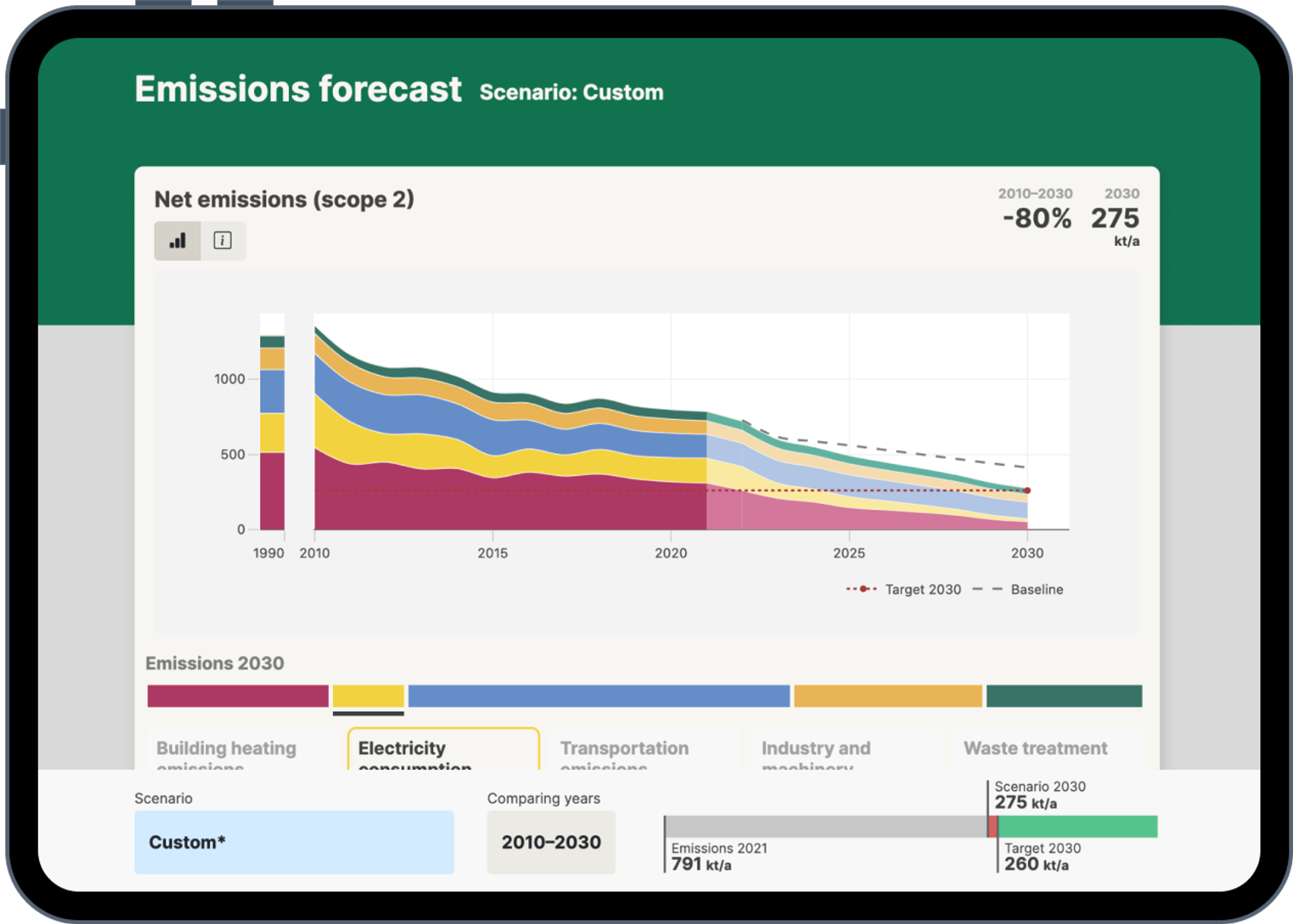
Collect all your climate data in one place and estimate the impact of your climate actions by building interactive visual scenarios.
Make impact visible
Kausal Paths is an interactive scenario modeling tool for calculating and visualizing the development of a city's greenhouse gas emissions and other impacts. It allows you to experiment with different combinations of emission reduction measures.
Making the impacts of different decisions visible, Kausal Paths facilitates the process among experts and decision-makers helping them choose an optimal combination of measures for the climate plan.
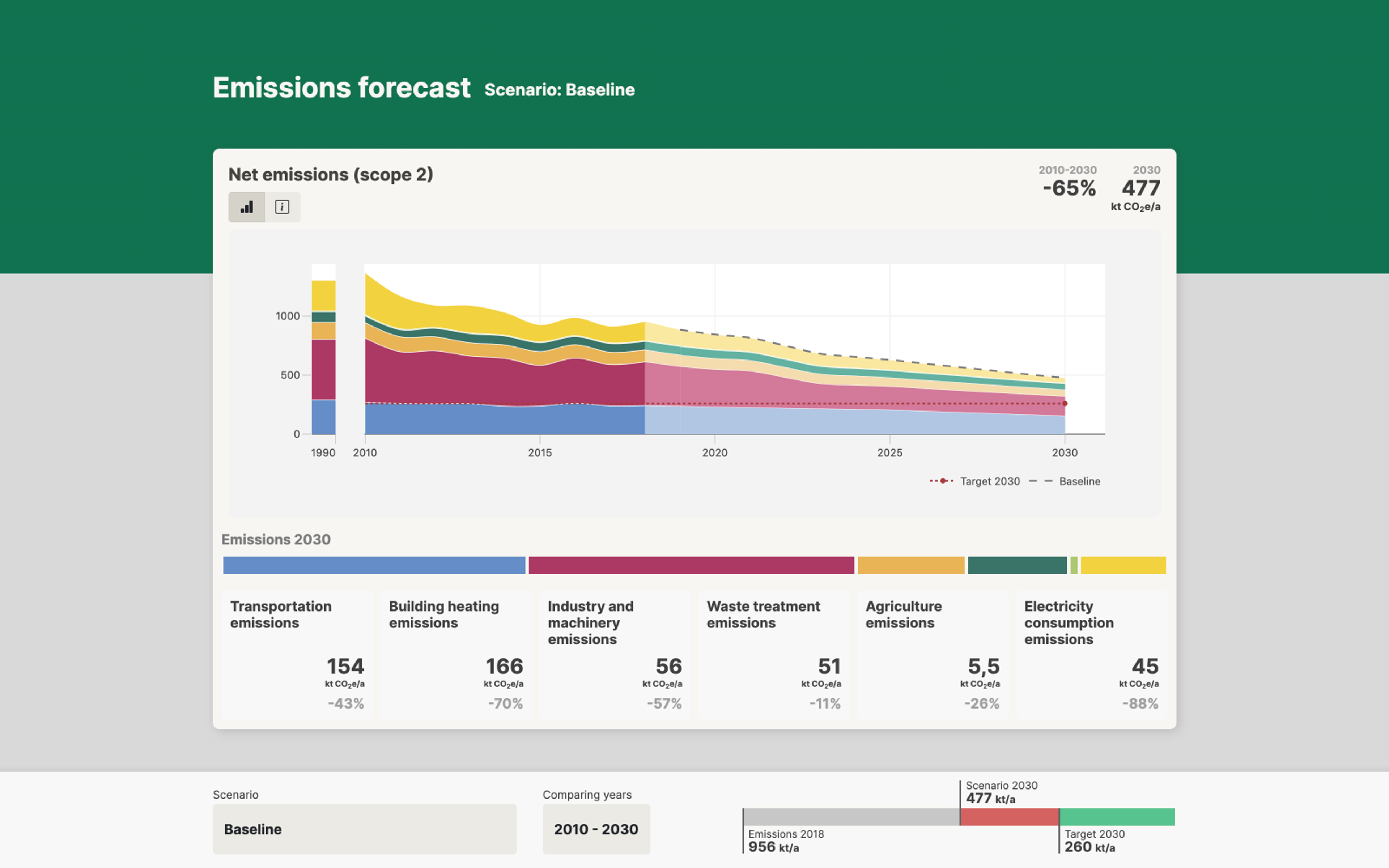
Build your understanding
The development of a city’s greenhouse gas emissions depends on factors such as population growth and application of new technologies, and of course on the implementation of the city’s climate plan.
Instead of having to rely on one-off studies that give you a static report that gets outdated very fast and whose assumptions might stay fuzzy, with Kausal Paths you can constantly update your understanding of the city’s progress in climate mitigation in a transparent way.
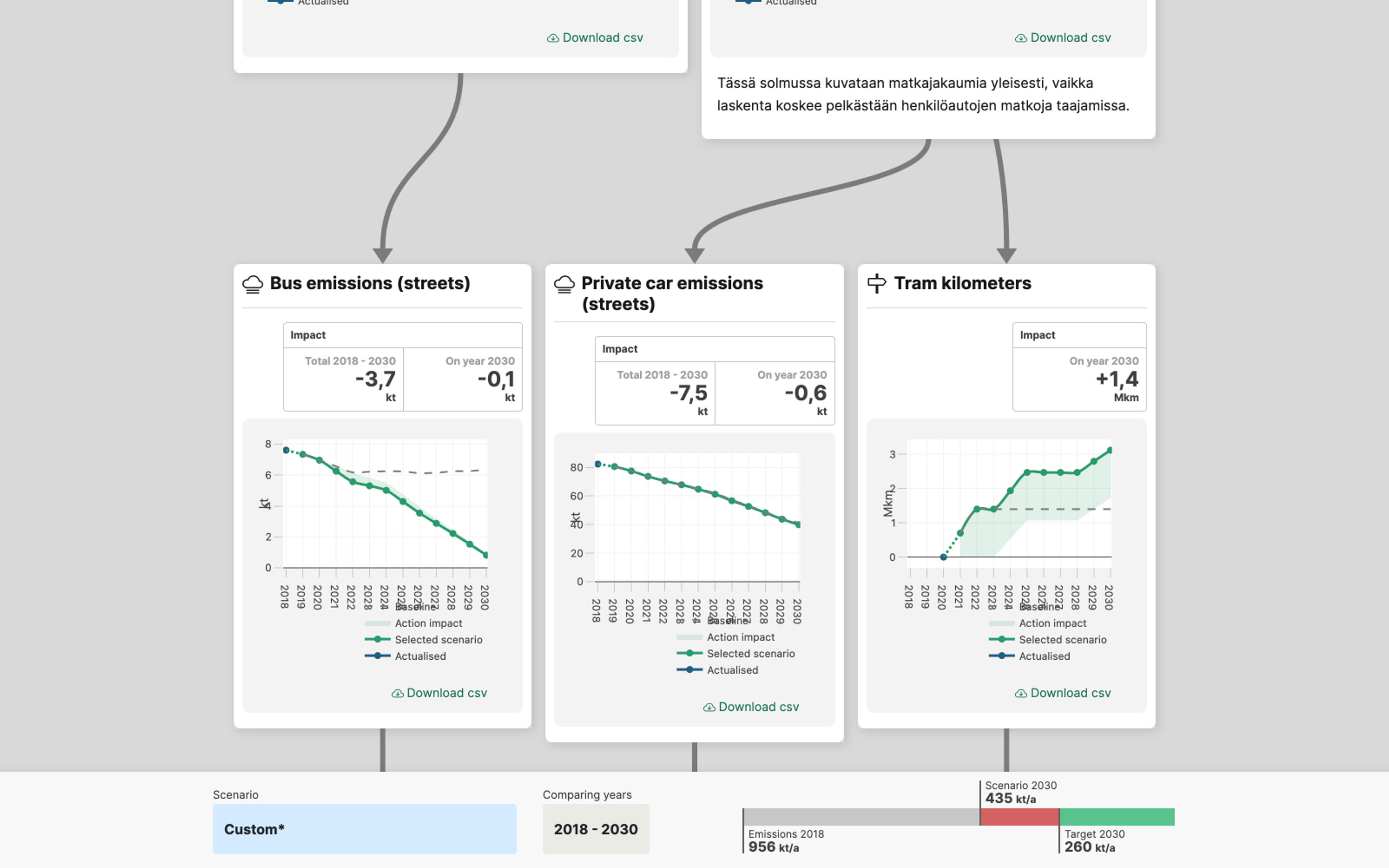
Compare scenarios
Kausal Paths works best when coupled with Kausal Watch. On Kausal Paths you can estimate the emission reduction potential of different climate actions: What happens to the emissions if the city builds a new tram route, what about when the city subsidizes energy renovations instead?
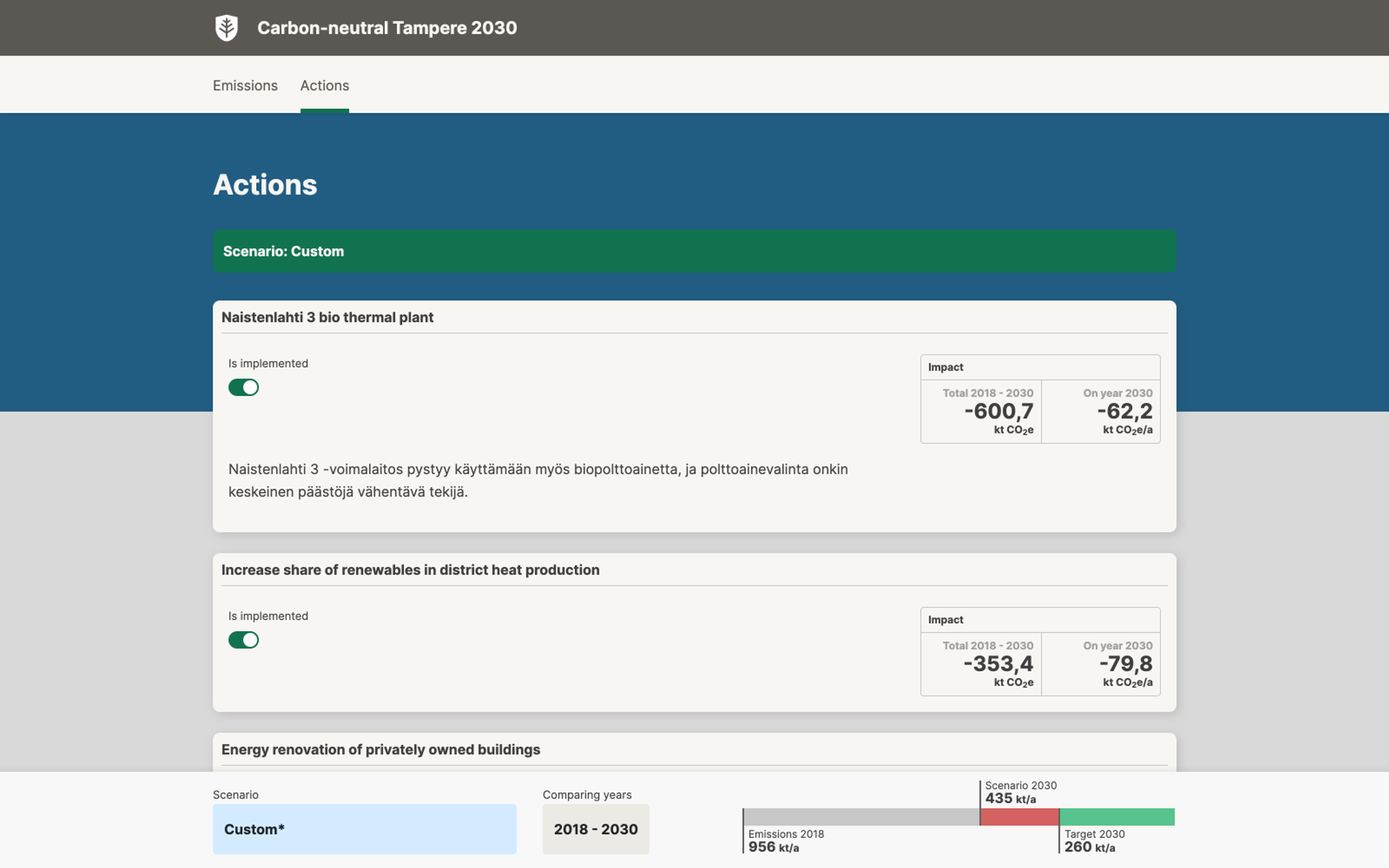
You can build different scenarios to support the decision making process. When the actions are decided upon, you can incorporate them into the climate plan in the Kausal Watch, where you can monitor, manage and communicate about their progress.
Learn more about Kausal Paths
Kausal Paths models the causal paths (hence the name) from each action to its outcomes, such as greenhouse gas emissions, costs and health impacts. It combines three kinds of input from your city: your past greenhouse gas inventories, the actions you want to model and their expected impacts, and background trends such as population and energy production. Kausal then runs the calculations in a common methodological framework aligned with standards such as BISKO, GPC, CDP and CIRIS. The model is easy to follow: each step describes its data sources and calculations, so you can click through it and see the assumptions behind every result.
Usually your city's historical emissions calculations, often based on a framework such as BISKO or GPC, and the climate actions you want to model. Our modelling team works with you to set up your model in Kausal Paths, make it interactively explorable and add the causal logic for forecasting future emissions. Setting up the model is a joint effort, and we support you closely throughout.
Kausal Paths presents your existing greenhouse gas inventory rather than creating it, and it is flexible about format, whether your inventory follows BISKO, GPC or another framework. Annual inventories in spreadsheet form can typically be imported automatically. The modelling itself is aligned with standards such as BISKO, GPC, CDP and CIRIS.
Kausal Paths shows your current emissions situation and a scenario all the way to your target year. It isn't real-time, though: the calculations are based on activity data, which is typically updated about once a year. Kausal Paths can also be connected with action tracking on the Kausal platform.
No. To avoid inaccuracies, we don't fill in missing data automatically. In most cases that's fine: the model still works if, for example, an indicator has no data for a particular year.
Yes. Kausal Paths scales easily. Even adding many more years of data causes no problems with storage or calculation, so you can model your plan all the way to your target year.
Kausal Paths helps you decide which climate actions to take by comparing their impacts in different scenarios. Once actions are decided, you can add them to your climate plan in Kausal Watch, where you monitor, manage and communicate their progress. Kausal Paths can also show your emissions situation and scenarios directly in Kausal Watch.
Yes. NetZeroPlanner is a free scenario tool we developed together with NetZeroCities. It is a good starting point for developing your climate plan, and the Kausal platform also offers templates that can be adapted to your city.