How Ludwigsburg simplified sustainability management with a single platform
Disconnected tools, siloed departments, and manual reporting create a coordination problem that grows over time. Climate and sustainability officers end up chasing updates across teams and producing reports that are outdated before publication. Ludwigsburg, a mid-sized city in Baden-Württemberg, faced exactly this challenge, and its solution offers a useful reference for other municipalities in the same position.
An outdated system holding back the city's ambitions
Ludwigsburg had been managing its urban development work through an in-house system that, by the city's own assessment, "had not proved its worth and was no longer up to date." The platform couldn't effectively track initiatives across departments, making it difficult to maintain oversight of work spanning climate and energy, mobility, culture, sport and health.
The consequences were practical. Coordinating with subsidiaries such as Stadtwerke and Wohnbau Ludwigsburg was cumbersome. Communicating progress to local councillors and citizens required significant manual effort. And without a clear, centralised view of all ongoing initiatives, demonstrating the value of the city's sustainability work - to decision-makers and the public alike - was harder than it needed to be. The city needed a different way of organising the work altogether.
Consolidating twelve plans into a single platform
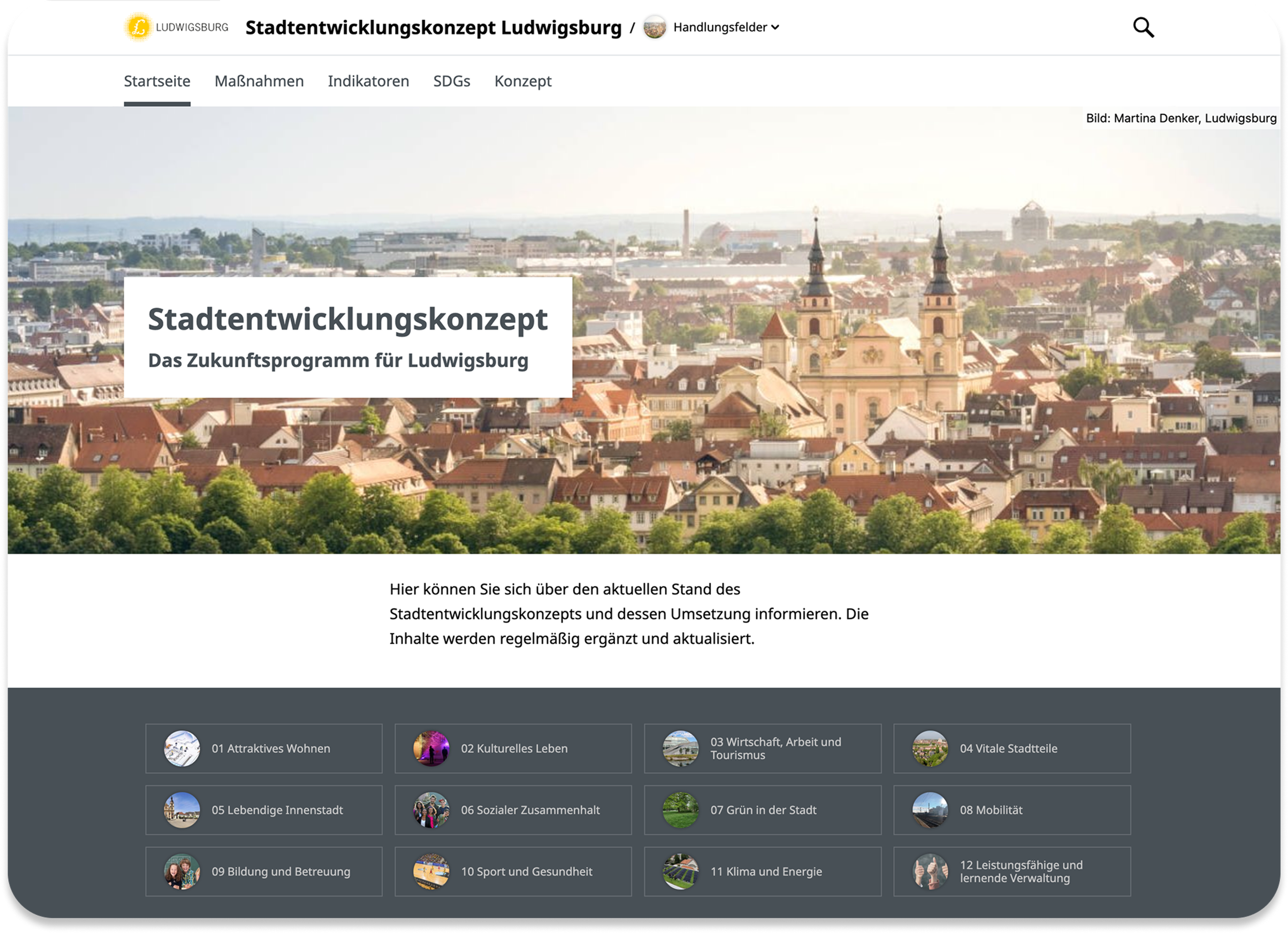
Working with Kausal Watch, Ludwigsburg brought 12 urban development plans into one integrated platform. The plans cover a broad range of urban priorities - from climate neutrality and energy to mobility, culture, sport and public health.
Ludwigsburg Stadtentwicklungskonzept
The decision to adopt a multi-plan approach proved central to making the system work. "In retrospect, it was a very good decision to opt for the multi-plan solution," the city noted. "Even though there are still some challenges, it works quite well."
The platform is publicly accessible at ziele.ludwigsburg.de, giving citizens, councillors and administrators a shared view of the city's urban development work. That transparency was deliberate, as the city explained:
"We wanted a system that can be used publicly and has a contemporary look, where everyone can view the information"
From coordination headache to connected workflow
The practical improvements are telling. Sustainability concepts and new initiatives can now be added to the dashboard with "very little additional effort for the admins," reducing the manual burden that so often slows momentum in under-resourced planning teams.
Cross-departmental collaboration - including with external subsidiaries - is easier because the platform is editable online rather than restricted to internal systems. SDG alignment is built directly into the workflow, allowing staff to assign Sustainable Development Goals to individual measures and filter initiatives by specific sustainability concepts. Monitoring progress toward climate neutrality goals, and reporting meaningfully on that progress, becomes considerably more straightforward.
The response from staff, councillors and citizens has been positive. The dashboard design "has been well received and praised by all our employees and external parties" - evidence that accessible design plays a role in public engagement with sustainability work.
Crucially, the platform goes beyond visualising goals. It incorporates the operational work - the measures and tasks required to actually implement each concept. Tracking outcomes without tracking the actions needed to achieve them is where many monitoring systems fall short. Ludwigsburg's setup addresses that gap directly.
What other cities can take from this
Ludwigsburg's experience will feel familiar to sustainability officers in cities of similar scale. The barriers it faced - outdated tools, cross-departmental friction, limited public visibility - are common ones. The good news is that they are also solvable.
The city now manages a broad portfolio of urban development work from a single dashboard, with a foundation for data-driven planning that is visible to everyone involved. For cities still working out of spreadsheets or legacy systems, that is worth paying attention to.
If you'd like to discuss how Ludwigsburg approached this - and whether a similar model could work for your city - get in touch with the Kausal team.